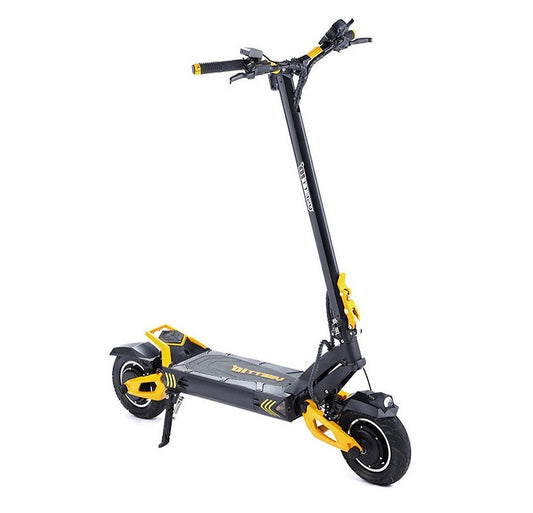
Can Electric Scooters Go Uphill?

One of the most common questions we hear from customers in Vancouver is: Can an electric scooter actually handle hills?
The short answer is yes but not all electric scooters climb hills equally well.
If you've ever tried riding up a steep street in North Vancouver, Burnaby, or parts of Coquitlam, you've probably noticed that some scooters maintain speed effortlessly while others slow down dramatically. The difference comes down to motor power, battery performance, rider weight, and scooter design.
What Determines Hill-Climbing Ability?
Motor Power

Motor power is one of the biggest factors affecting climbing performance.
A basic commuter scooter with a 350W or 500W motor may handle gentle inclines, but steeper hills often cause noticeable speed loss.
As hill grades increase, scooters with 800W, 1000W, or dual motors generally perform much better because they can deliver more torque to the wheels.
However, motor wattage alone doesn't tell the whole story. Controller tuning, battery output, and overall scooter weight also affect real-world climbing ability.
Single Motor vs Dual Motor Scooters

Dual motor scooters typically outperform single motor models on hills.
With power delivered to both wheels, traction improves and the load is shared between two motors rather than one.
For riders who regularly encounter steep terrain, models such as the NAMI Klima, Kaabo Wolf Warrior 11+, or VSETT 10+ Dual Motor offer significantly better climbing performance than entry-level commuter scooters.
That doesn't mean everyone needs a dual motor scooter. Many urban riders can comfortably manage moderate hills with a well-designed single motor model.
Battery Matters Too

Many riders focus only on motor wattage and overlook battery voltage.
Higher-voltage systems can generally maintain performance more effectively under heavy load. As battery charge decreases, lower-voltage scooters may experience a more noticeable reduction in hill-climbing performance.
This is one reason premium scooters often use 52V, 60V, or higher battery systems.
Rider and Cargo

The same scooter can perform very differently depending on who's riding it.
A 70 kg rider may climb a hill comfortably, while a 110 kg rider carrying a backpack could experience significantly slower speeds on the same incline.
Manufacturers often publish maximum climbing angle figures, but those numbers are typically achieved under ideal conditions.
Real-world results depend heavily on rider weight, road surface, battery charge level, and weather.
How Steep of a Hill Can an Electric Scooter Climb?
There is no universal answer because every scooter is different.
Generally speaking:
| Scooter Type | Typical Hill Performance |
|---|---|
| 350W–500W commuter scooters | Mild hills |
| 800W–1000W scooters | Moderate hills |
| Dual motor performance scooters | Steep urban hills |
| High-performance dual motor models | Very steep terrain and off-road climbs |
Keep in mind that climbing ability is usually more important than top speed for riders living in hilly areas.
Vancouver Riders Face Unique Terrain
British Columbia riders often deal with terrain that is far more demanding than many other Canadian cities.
Areas such as North Vancouver, West Vancouver, Burnaby Mountain, and parts of Port Moody feature long sustained climbs that can challenge lower-powered scooters.

If your daily commute includes significant elevation changes, it's usually worth investing in a scooter designed specifically for hill performance rather than choosing solely based on speed or price.
You may also find our guide on Best Electric Scooters for Vancouver Hills helpful when comparing models.
Can Hill Climbing Damage an Electric Scooter?
Not necessarily.
Quality scooters are designed to handle hills within their intended performance range.
Problems typically occur when riders repeatedly push underpowered scooters beyond their capabilities. Extended climbs can generate additional heat in the motor and controller, especially during hot summer weather.
Following manufacturer recommendations and choosing a scooter appropriate for your terrain helps reduce unnecessary stress on electrical components.

The Bottom Line
Yes, electric scooters can absolutely go uphill—but performance varies dramatically between models.
If you ride mostly flat bike paths, a basic commuter scooter may be perfectly adequate. If your routes regularly include the steep streets commonly found around Vancouver and surrounding areas, a more powerful scooter with a higher-voltage battery or dual motors will provide a much better riding experience.
When evaluating a scooter, look beyond advertised top speed and pay close attention to motor power, battery system, rider weight capacity, and real-world hill-climbing capability.